SEASONAL SELF-CARE BLOG
Spring Cleanse
Posted on May 13th, 2015

I just made my first batch of Kitchari for my Spring cleanse. It is delicious and I feel ready to detox! Now that the weather is warm, it’s the perfect time to dive in and do your Spring cleanse! In fact every cell in your body is begging you to cleanse the congestion out of your liver and gall bladder organs. Once cleansed, your will feel calm, stress and tension free, decisive, insightful, emotional ease, and in contact with our personal power and capacity for leadership that are the attributes of a balanced liver network. Invite a state of balance and vibrancy into you being!
It is often difficult to slow down our busy lives and take the time to properly do a juice cleanse. Particularly if you are vata dosha, it is more effective do a traditional Indian Kitchari cleanse for 3-5 days. Kitchari is a simple cleansing highly nutritious combination of mung beans and rice. It both cleanses your system and strengthens your memory.
Whether you choose to do a juice cleanse, or a mono diet like kitchari, it is essential to offer ways for the toxins to leave your body. I find it most effective while doing a cleanse to be sure to continue to take plenty of balancing, nourishing and purifying baths. The skin is the largest organ in your body and a large part of our detoxification process. See our Spring Practices post on purifying seaweed baths!
KITCHARI
by Annie Kunjappy
chef for Yoga Sukhavati Seasonal self-care workshops
1 cup mung beans (soaked overnight)
1 cup brown basmati rice
1 onion diced
8 cloves garlic chopped
1 cup finely sliced leeks
1” piece ginger chopped
4 Tbsp coconut oil
2 tsp ground coriander
2 tsp ground turmeric
1 cup chopped scallions
½ cup chopped cilantro/parsley
Sea salt and lime/lemon juice to taste
Cook mung bean in pot with 4 cups of water and a half teaspoon of sea salt until soft.
Cook basmati rice in 2 cups of hot water until done.
In a separate pan, heat coconut oil, sauté onions until soft. Add leek and continue until soft. Add garlic, ginger, coriander and turmeric and sauté for 1 minute.
Mixed together the cooked beans and liquid with the cooked rice, and the sauted ingredients.
Add chopped scallions and cilantro.
Season with lime juice and sea salt to taste.
Q & A with Margherita Tisato
Posted on April 23rd, 2015
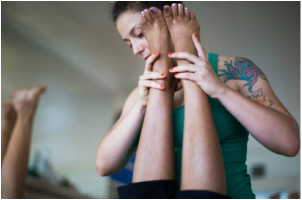
We chatted with Yoga Sukhavati graduate Margherita Tisato about yoga, teaching, and how the Yoga Sukhavati 300 YTT transformed her life and practice.
When did you start practicing yoga? How did you find yoga?
I started practicing yoga officially back in 2000, in Milan Italy, where I’m from. I say “officially” because I was studying dance at the time and my dance teacher was a yogini and incorporated a lot of breath work, seasonal practice and energy work in her teaching. Sometimes I feel like I’ve been practicing yoga for all my life!
How has the practice changed your life?
Once I started practicing consciously, meaning once I started to differentiate my dance-art practice from my yoga practice, the more subtle benefits really started to kick in: non-competitiveness, acceptance, surrender, compassion, self-care...
What were you doing before you took your training?
Before my first training I was working as a dancer and a make-up artist: the dancer part I loved but didn’t pay. The make-up artist paid well, but was extremely taxing because of schedule and politics involved. The more I practice yoga (especially incorporating the Yamas and Niyamas, or code of conducts), and the idea of yogic ethics, the more the entertainment industry became hard to digest.
Why did you decide to take a 200-hr teacher training?
It took me a few years of dedicated practice before I decided I was ready to take a training. Even though I had been teaching dance for years at the time, the idea of leading others in such a transformative practice with all its many layers and facets was still daunting. To this date, I find teaching yoga much more intense than teaching dance or Butoh, due to the therapeutic value that these practices have.
What stands out the most about your experience from your teacher training?
My training was deeply experiential and unsettling in some ways. Lea Kraemer, my first teacher is a true seeker and opened the doors for me to explore without fear of judgment.
How has the Yoga Sukhavati training transformed your life? What are you doing now?
I became more aware of my responsibilities towards myself. More aware of the importance of finding a voice that comes from direct experience, while honoring and respecting traditions. I found the drive toward constant learning and acceptance toward constant transformation. There is no one way of doing anything, nor one fixed thing we can “sit” on and lay back, if we really walk this path. I learned to be fearless in my teaching because I learned how to teach from the heart.
How was it to work with Leigh?
Inspiring. Humbling. Fun!
What advice would you give to someone who was on the fence about doing a 200-hour teacher training?
Be open to the experience. The mind guides us most of our lives. We can learn and memorize so much and so many books in a lifetime, but this learning will not replace the embodied experience. Frightening as it is, the sacred space Leigh creates will hold you safely to allow you to surrender to the experience.
What stood out to you about the Yoga Sukhavati 300-hour Advanced training?
The most challenging and rewarding part of this training was the high value given to self-care and truthfulness. In a very innovative yet classical way, Yoga Sukhavati brings to light the true voice of each of its trainees in a unique and powerful way. And self-discovery is never easy!
What do you like most about teaching yoga?
I believe teaching is my mission. I don’t necessarily “like” teaching yoga. I find it challenging and inspiring, and rewarding and terrifying all at the same time, everyday. But it’s what I do, and where I feel at my fullest, most of the time.
You can find Marghertia at Loom Yoga Center in Bushwick.
Leigh Evans and Yoga Sukhavati
Posted on April 14th, 2015
Leigh Evans muses on yoga, internal investigation and transformation and her upcoming Yoga Sukhavati 200 HR Teacher Training in Nicaragua.

How long have you been practicing yoga? How long have you been teaching yoga?
In 1986, I had the great fortune to walk into the class of Dharma Mitra here in New York city. I was blown away by him and how yoga released the anxiety I was feeling as a young struggling dancer in NYC. After that initial class I felt so calm and peaceful. I went back everyday for 6 months and took everyone I knew to the class. I’ve been practicing yoga ever since. Wow, it’s been 29 years that I’ve been practicing yoga!
I’ve been teaching for 21 amazing years!
How did your first yoga teacher training change your life?
My first teacher training was in 1993 with Rodney Yee. I was lucky to live very close to the Piedmont Yoga Studio in Oakland, CA where Rodney was teaching. It was his first teacher training and we all had such an amazing time exploring asana. He’s a very creative person and was continually exploring to see what works to open the body. Through the practice of teaching in the training I became empowered to speak. My voice had always been one of my issues. Prior to that I really had difficulty speaking to people and was shy in front of a group. The teacher training provided me with a deep investigation and understanding of the body through the asana practice and also with a voice to share with other people. Teaching has really opened me up to other people.
You have extensive experience training with some of the best teachers in their respective fields, all over the world. Is there one teacher that has influenced you the most over the years?
I truly have been blessed by studying with the finest teachers. I seek out the best and am grateful that I have had the opportunity to learn from such incredible teachers.
When looking back I think my yoga path has been most significantly influenced by Sarah Powers. She is an amazing yogini, devoted to exploring practices that offer paths to awakening and freedom. She is continually seeking, learning, exploring and sharing what has helped her the most. I have witnessed her teaching change over the years. She is not afraid to let go of the practices that are no longer necessary for her. When I did my teacher training with with her in 2000, she was primarily a yoga teacher and had just started exploring meditation. Over the past 15 years her teaching has shifted significantly to be more focused on yin yoga and meditation. It was through my studies of yin yoga with Sarah that I was introduced to yoga practices that targeted specific meridians and organs. I continued that exploration as I delved deeper into the theories and practices of Ayurveda and chinese medicine and developed the Yoga Sukhavati seasonal practices.
What were you doing before you taught yoga full time?
My life was devoted to pursuing art and performance as a dancer and choreographer. I was working as a production artist in a graphic design firm which meant I spent all day sitting in front of a computer. The work that I got paid for was killing my body and my soul. I was miserable and my neck and back hurt all the time. At some point I just couldn’t take it anymore. I quit my job, went to India for 5 months and studied yoga and Odissi dance, (indian classical dance). After my journey, I vowed not to return to work that made me so unhappy and i started teaching yoga full time.
What do you enjoy about teaching yoga teacher trainings?
I love offering the opportunity for students to slow down and take the time to truly investigate. In our current fast paced lives and quick vinyasa practice, we rarely have the opportunity to listen deeply to what is happening inside. The Teacher Trainings provide an oasis of time and support through the deepening of the asana and meditation practices to go inside and really see what is happening in our bodies and minds. Through the process of bringing our habitual tendencies to consciousness we open to insight, choice and freedom. It brings me such joy to guide and witness the transformation of my students as they develop the skills and awaken their voice and presence through taking their seat as the teacher.
In your opinion, what is the benefit to doing a training abroad, vs. staying in your community?
When people take a teacher training in the midst their busy lives, they often feel overwhelmed. It is difficult to let go of the distractions and necessities of work and relationships in their home life. Carving out the time to fully commit to practice and study in a teacher training immersion abroad offers an invaluable supportive oasis. The Immersive retreat offers the freedom to completely devote yourself to your yoga practice and studies. As you remove yourself from your jam packed schedules and distractions of your daily life and dedicate time to practice, your body relaxes, your mind quiets and you reconnect with the essence of your being. The retreat environment fully supports you, so you can dedicate yourself to study. Your practice and awareness will soar to new levels!!
What are you most excited about for the 200 hour Yoga Sukhavati YTT in Nicargua?
For the 200 hour teacher training in Nicaragua I’m looking forward to being immersed in such a beautiful blessed environment that will offer all of us support. As a teacher, it is such a wonderful opportunity to release into just teaching and being. Embraced by this support, my presence and awareness will deepen and my clarity for teaching and seeing what the students need will expand. It is a rare gift of time and support.
How did you pick Nicargua for this particular training?
I like to offer trainings and retreats in pristine remote locations where the students will be immersed in natural beauty as well as exposed to new cultures. Nicaragua does not have as large of a tourist industry as some of it’s neighbors, so it will be easier to experience the real culture and get to know some of the Nicaraguan people. I’m very excited about this. Our retreat center, Costa Dulce is an absolutely gorgeous location. We have our own private secluded beach just steps away from our yoga studio. July is supposed to be the best time for surfing!
Can you give an example of what a typical day of training would look like?
Sample day
6:00am Wake up-take a dip into the ocean!
6:30-7:15am Meditation
7:15–7:30am Fruit & tea
7:30-9am Asana practice
9:00-10:15am Breakfast
10:30am-12:30pm Asana investigation
12:30-3pm Lunch & free time
3:00-5:00pm Seminar (philosophy, ayurveda, anatomy, etc.)
5:00-7:00pm Asana adjustments
7:00-8:00pm Dinner
8:00-9:00 pm Class if needed
How do you know Diane and Ira? What specialities will they bring to the training?
Diane Sherman is a friend and yoga colleague of mine from when I lived in Oakland, CA. She is a very creative and vibrant person, yogini, teacher, artist, and poet. She has also studied extensively with Sarah Powers so our teaching perspective is aligned.D iane will be teaching Asana with me as well as yoga philosophy. She has a life-long practice of journaling which inspired her to create a beautiful online course “Zen to Paper” in which she invites people into the world of journaling. She will be sharing her creative journaling techniques inviting the students in the training into a personal investigation of the Yoga Sutras.
Ira Macner is the anatomy teacher for the Greenhouse teacher training that I have been directing for the past 5 years. She is a wonderfully warm person and a great anatomy teacher. She brings Anatomy alive with her excellent sense of humor and thorough understanding of the body from her years as a massage therapist as well as a yoga teacher.
If there is one take-away you hope your 200-hour Yoga Sukhavati graduates have, what would that be?
I hope to be able to help people see where they are stuck in their bodies and minds and through that awareness open the path to freedom. Whether the obstruction is physical, mental, or emotional, I hope the transformative process of the 200-hour training will provide graduates with the skills to witness these habits and release the patterns that are holding them back and embrace practices that help them be their most vibrant and loving selves.